Verity / Certificate of authenticity
The Entrupy certificate of authenticity
An Entrupy certificate of authenticity is a digital document issued when a check has confirmed that an item is genuine. Below is a breakdown of how it is put together, what exactly it confirms, what it does not, and how a buyer can make sure they are looking at a real certificate rather than a picture of one.
What the certificate looks like
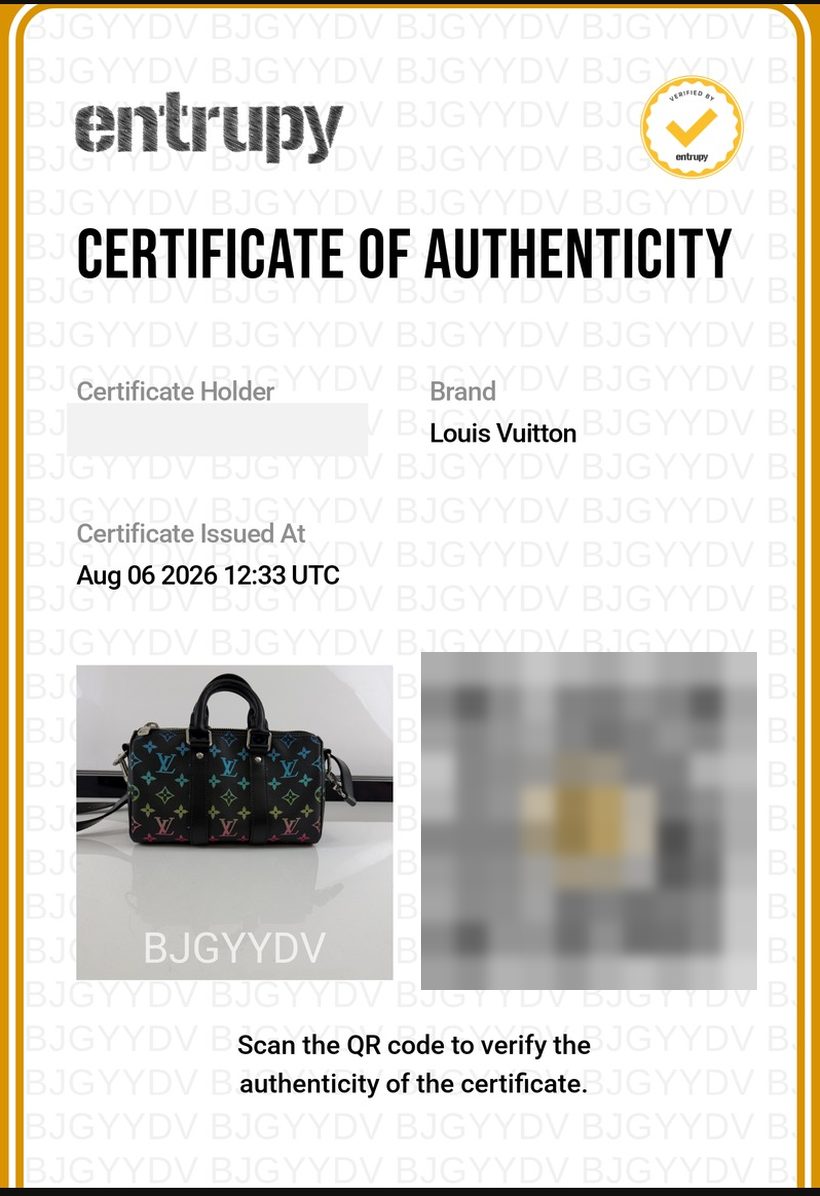
The document is generated on Entrupy's side in a single format used in every country, and it is issued in English. The set of fields is the same for every category of item.
- Certificate of Authenticity and the Verified by Entrupy mark
- The heading of the document and the brand seal. On their own they prove nothing — an image is easy enough to reproduce, so verification does not rest on them.
- Certificate Holder
- The organization whose Entrupy account was used to run the check — in other words, the provider of the service. The owner's name is not here, and should not be — see the section below.
- Brand
- The brand of the item that was checked.
- Certificate Issued At
- The date and time of issue in UTC. The moment is recorded to the minute.
- Photograph of the item
- A shot of the exact item that was checked. This is the key element of the document: it ties the certificate to one specific item rather than to a model.
- QR code
- Leads to this certificate's page on the Entrupy website. The only way to verify the document.
- Certificate number as a watermark
- A seven-digit code is applied as a repeating pattern across the whole face of the document and over the photograph of the item. It cannot be removed from the image without damaging the document.
What the certificate confirms — and what it does not
This distinction is worth spelling out before a deal, because otherwise it surfaces after one.
It confirms: that one specific item was checked with Entrupy technology on the date and at the time stated, and that the analysis confirmed it to be genuine.
It does not confirm: ownership of the item, its value, condition, completeness or history. A certificate is not an appraisal and not an owner's title document — it is the record of a check that was carried out.
Why the owner's name is not on the certificate
Almost everyone who sees the document for the first time asks the same thing: why does the Certificate Holder field name neither them nor the shop where the item was bought.
The reason lies in the nature of the document. The certificate records the result of a technical check, and the holder named on it is whoever performed that check — an organization with an account in the Entrupy system. Ownership of the item, meanwhile, can change hands any number of times: the bag is sold, given away or inherited, while the certificate goes on describing the same item and the same completed check. That is exactly why it does not need to be reissued on resale — and exactly why it carries any weight as an argument for the buyer in the first place.
How to verify a certificate
What a buyer should do when a seller shows them a certificate:
- Scan the QR code with your phone camera. The certificate's page on the Entrupy website will open — the address in the browser bar must lead exactly there.
- Compare the photograph on the page with the item in front of you. It is not the model that has to match but the individual item: the position of the hardware, the shade, the wear marks, the particulars of the pattern.
- Check the brand and the date of issue against what the seller is telling you.
- Make sure the certificate number on the page matches the watermark on the document itself.
An image someone sends you cannot be trusted — the only thing worth trusting is the page opened via the QR code on the document itself. A picture can be edited; a page on Entrupy's side cannot. This one rule answers almost every question about how far to trust someone else's certificate.
Why a certificate matters on resale
"Is it definitely genuine?" comes up in every second conversation about selling a luxury bag, and it usually leads nowhere: the seller gives assurances, the buyer does not believe them, the price gets talked down. A certificate moves the argument out of the realm of trust and into the realm of a verifiable fact — the buyer can check for themselves, without relying on anyone's word.
For businesses the effect is the same, only at scale: a pawnshop decides whether to buy on the basis of a document rather than an appraiser's opinion; a consignment store closes off the risk of returns; a resale platform gains grounds for the guarantees it gives its own buyers.
Where the certificate is stored
Every check run by a partner organization — the statuses, the dates and the certificates issued — is stored in the Verity app and available at any moment as reporting under the contract. There is no need to download the documents and file them separately: the check history stays accessible even if a particular link has been lost.